One home per colored area
Every region contains exactly one cat. Once you place it, the rest of that region can be removed from consideration.
 mewdoku.live
The cat puzzle field guide
Open the guideMeowdoku, one deduction at a time
Find a place for every cat. Make sense of every move.
Get it on Google PlayNapdoku · A related cat puzzle for Android
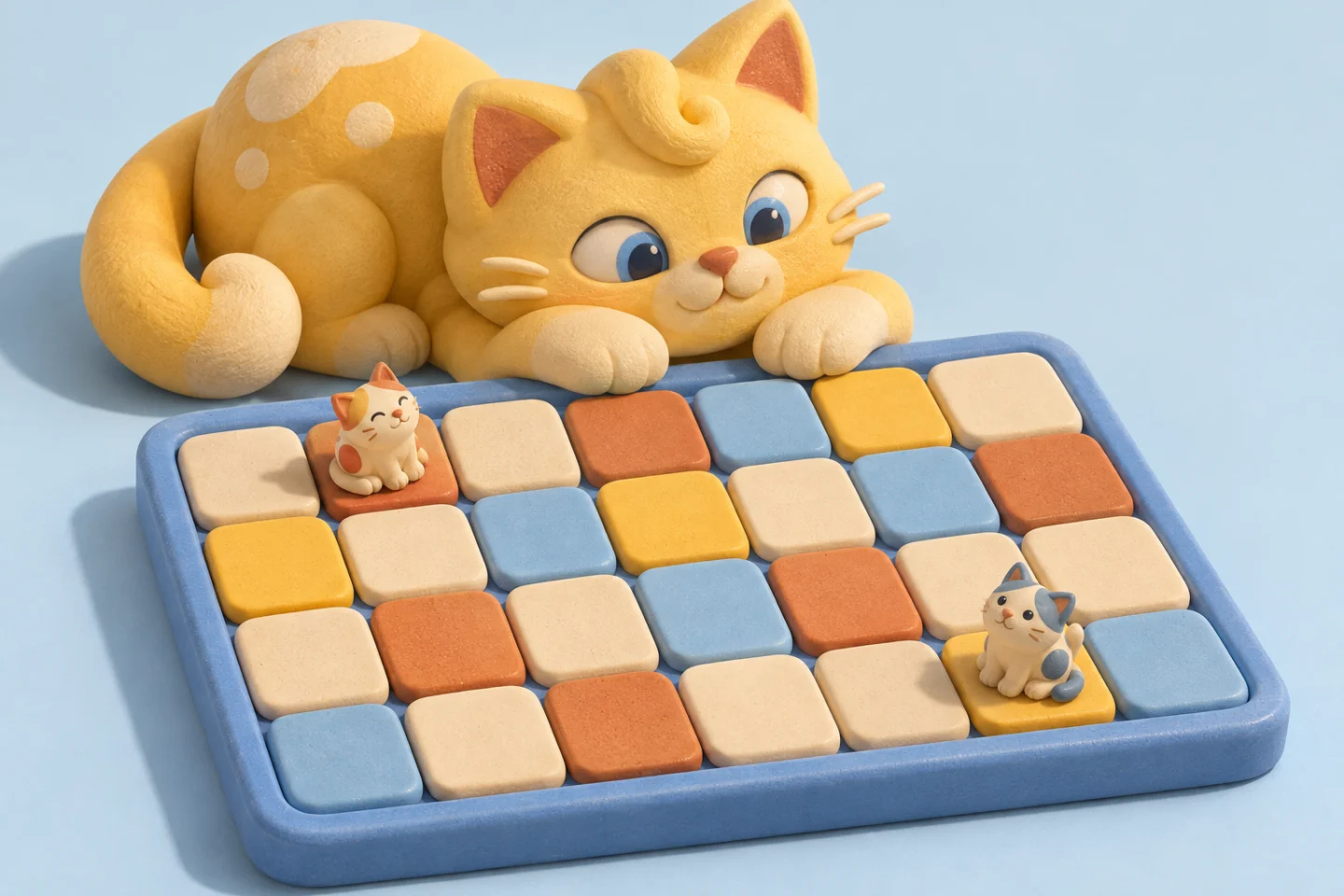
Meowdoku tutorial
A puzzle becomes easier to read when you can explain why a square is available.
Meowdoku is a cat-placement logic game. Each colored region needs a cat, and the cats need separate rows, separate columns and space between their corners. The interesting part is how those requirements overlap.
Begin by tracing the colored boundaries. Two squares can share a color without sharing a row. A region can stretch across several lines. Look at the actual shape before deciding which square seems convenient.
Next, find any cats already on the board. Follow each cat’s row and column to both edges. Then check its four diagonal neighbors. Those exclusions give you a useful starting map of the remaining choices.
In the mobile game, double-tap a square to place a cat. Before doing that, ask whether another legal square could still serve the same region. If it could, you may need another deduction before committing.
Every region contains exactly one cat. Once you place it, the rest of that region can be removed from consideration.
One cat rules out its entire row and column. Carry the check across color boundaries and all the way to the edge.
Two cat squares cannot meet at a corner. A placement blocks all four immediately diagonal squares.
A square is legal only when it passes every check. A legal square becomes certain when the other options have been eliminated.
Meowdoku hearts
A wrong placement costs a heart in Meowdoku. That makes an extra moment of checking worthwhile, especially when two squares look equally convincing.
Use the board’s marks to record squares that have a definite conflict. A mark should mean something specific: this row already has a cat, this region is filled, or this square touches a cat diagonally.
A common mistake is to mark an awkward-looking square without a rule that excludes it. A few uncertain marks can make a valid region appear impossible. When that happens, retrace your recent exclusions before guessing.
Before the double-tap, finish the sentence: “This square must hold the cat because…”
If the explanation is “it seems likely,” keep looking. Try another region, or see whether the remaining candidates are concentrated in a single row or column.
A small deduction workshop
These are illustrative situations you can recognise on many boards. Open each one after you’ve thought about the next step.
You don’t yet know which candidate will hold the cat. You do know that the row’s cat belongs to this region. Remove the squares in that row that belong to other regions.
This can unlock a neighboring region while leaving the original two candidates unresolved.
Check the surviving square against the region, row and column rules. If it passes and it is the region’s only remaining candidate, its placement is forced.
The region’s cat must occupy that column. You can therefore rule out squares in other regions along the same column, even before choosing the exact square.
As boards get busier, you have more candidates to track. The rules stay useful. A consistent solving routine helps you avoid rechecking the same squares without learning anything new.
Count what remains after exclusions. Region size alone can be misleading: a large area crossed by several occupied lines may be more restricted than a tiny area.
A region confined to a row or column gives you an exclusion elsewhere. Use that information before deciding you have no move.
After placing a cat, examine the regions that lost a candidate. A region with two choices a moment ago may now have a single answer.
Check the latest marks for a clear reason. Restore any square you excluded without enough evidence, then run the three placement checks again.
When you search for Meowdoku answers or a walkthrough, compare the board itself with the guide you find. A level number alone gives less information than the region layout and the cats already placed.
If you enjoy the moment when a single exclusion unlocks a board, look for puzzles built around clear placement constraints. Sudoku uses rows, columns and boxes. Region-placement puzzles add the shapes of colored areas to your reasoning.
When comparing games, read the rules for diagonal contact and region counts carefully. Similar-looking grids can use different constraints. The habit worth carrying across is explaining an exclusion before treating it as certain.
For another Android cat puzzle, the button at the top of this page opens Napdoku. For the original Meowdoku app, use the Oakever Games listing linked in the questions below.
The available content depends on the app version and its updates. Check your installed game for current progression and the store listing for release information.
Meowdoku is published by Oakever Games. Open the original Meowdoku page on Google Play to check availability and the current app details.
First check for a cat in the same region, row or column, then inspect the four corners. Passing a quick line check can still leave a diagonal conflict.
This is an independent tutorial and strategy guide. The practice panels explain deductions using short examples. They do not run the app or reproduce its levels.
A solver searches for a complete arrangement that satisfies the rules. This guide focuses on deductions you can verify yourself, so you can follow why a placement works.
Check the current store page for pricing, advertisements and in-app purchases in your country. These details can change between releases.
The 3D scenes are original illustrations. Use the written rules and the practice explanations when reasoning about your own board.